
The Problem of Burglary of Retail Establishments
Retail burglaries are a problem for many communities. A British survey found that stores lose as much to burglars as they do to shoplifters. These losses impact the viability of businesses and, consequently, of the communities around them. Although much research has been conducted on burglary in general, little of it has specifically focused on retail burglaries—break-ins at stores to steal cash or goods.† However, the research that has been done points to a number of effective responses to the problem. This guide reviews what is known about retail burglaries, suggests ways to analyze them in your jurisdiction, and provides guidance as to appropriate responses.
† This guide also covers smash-and-grabs and so-called "ram raids." Smash-and-grabbers rely on the element of surprise to break display windows or showcases and escape before the alarm sounds. Ram raiders use stolen vehicles to smash their way into buildings, usually after hours. They grab what they want and make a quick escape, often in another vehicle.
The businesses covered in the guide include shops in downtown areas, in strip malls, in covered malls (or "shopping precincts," as they are known in the United Kingdom), and in retail parks. They also include stand-alone superstores, neighborhood stores and rural stores, as well as restaurants, beauty parlors and off-track betting establishments. Not covered are wholesale warehouses or retail outlets in industrial parks.
Related Problems
The problem of retail burglaries needs to be distinguished from those of (1) other retail thefts and (2) other commercial burglaries. These problems, which should be addressed separately, include:
- Robberies of retail establishments
- Shoplifting
- Stockroom thefts by employees
- Thefts by delivery personnel
- Insurance frauds involving false burglary reports made by store owners
- Burglaries of banks (considered a separate problem due to banks' much greater security)
- Burglaries of other commercial spaces such as offices, manufacturing premises, transport facilities, construction sites, and cargo-handling facilities
- False burglar alarms.
Compared with residential burglaries, commercial burglaries—especially retail burglaries—have been the subject of few studies. In part, this is due to the much larger number of residential burglaries, but it is also generally believed that commercial burglaries have less serious consequences for victims and for the community at large. However, growing recognition of the important part small businesses play in urban regeneration has heightened concern about crimes that might reduce their viability.1 In turn, this has led to more research on crimes against businesses (including retailers), particularly in the United Kingdom, Holland and Australia. As a result, we now know more about retail burglaries, though our knowledge is still patchy. The following are the best-established facts:
- Even though there are considerably fewer retail burglaries than residential burglaries, the risk of retail burglary per number of premises is very high. For example, a national survey in Britain found that, in 1993, 24 percent of retail establishments were burgled, compared with just 4 percent of residences.2, † This is because stores tend to be empty at night; may, if big, offer many entry points to burglars; and may contain a lot of goods (and, sometimes, cash).
- Most retail and residential burglars are young men who commit a variety of predatory crimes. Interviews reveal that their main motivation is economic, though some burglars also claim to enjoy the excitement. They do not do much planning, but show some care in selecting "safer" targets. They claim to be little deterred by physical security, but try to avoid being seen. Many have drug or alcohol habits.3
- A small number of retail burglars are highly prolific, accounting for many burglaries. Some retail burglars are also more sophisticated in their planning and methods. They work in small gangs and generally rely on disabling the alarm, which allows them more undisturbed time on the premises. They target high-value goods and the safe, which they may remove entirely.
- Most retail burglaries occur at night or on weekends, when stores are closed (while most residential burglaries occur on weekday afternoons, when residents are not likely to be home).4
- Retail burglars generally enter the premises through doors or windows. They force door locks, break through doors or side panels, or force/break windows. The use of vehicles to break through doors or windows (ram raiding) is much less common.†
† For example, the commercial victimization survey conducted by the British government in 1995 found that only 2 percent of break-ins were ram raids (Mirlees-Black and Ross 1995).[Full Text]
- Substantial variations in burglary risks exist among stores, depending on the location, premises, goods sold, and security.
- As with some residences, some stores suffer substantial repeat victimization.5 This is due to their location or security, the attractiveness of their goods, and the fact that, once successful, burglars may strike the same premises again. National data for Britain show that 2 percent of retail premises experienced a quarter of the retail burglaries in 1993.6 A repeat burglary can occur soon after the initial one—usually within a month.7
- The average financial loss due to burglary is about 20 percent greater for stores than for residences. Perhaps for this reason, a larger proportion of retail burglaries (about 95 percent) are reported to the police than domestic burglaries (80 to 85 percent).8 According to a national British survey of retailers, stores lose as much to burglary as to shoplifting, and only very rarely recover stolen goods.9
- Burglary, especially repeat burglary, can have serious consequences for stores. They can become insolvent, and owners are sometimes forced to lay off staff, increase prices or close the stores. Staff can suffer psychological effects similar to those suffered by people whose homes have been burgled.10 They report feeling that their personal space has been invaded, and they worry that the offenders might return when they are on the premises.
- Unless burglars are caught in the act, they are very difficult to detect. The clearance rate for burglaries as a whole (figures for retail burglaries are not available) is the lowest for the eight UCR index crimes.
Factors Contributing to Burglary of Retail Establishments
Understanding the factors that contribute to your problem will help you frame your own local analysis questions, determine good measures of effectiveness, recognize key intervention points, and select appropriate responses.
Not all stores face the same burglary risks. Some are in areas with low crime rates, and some are not. Some are open for longer hours, perhaps around the clock. Some sell goods that are less attractive to thieves due to their low value or bulk. Some are located where they receive constant surveillance from passing traffic or pedestrians. Research tends to confirm these factors' effects on burglary risks, though there are several reasons why we can draw few definitive conclusions:
- As mentioned, researchers have only recently begun to focus on retail burglaries, and we still lack large studies (particularly in the United States) that have adequately measured important risk factors.
- Many of the risk factors overlap. For example, liquor stores in deprived areas might be at greater risk because of their location and the goods they sell. However, owners are aware of the risk, and they might have more security in place than owners of other neighborhood stores or of liquor stores in safer areas. To sort out these relationships would require a very large and complex study.
- Many risk factors, such as the strength of window bars or the ease of driving vehicles to the back of a store, are quite subtle and difficult to measure in large surveys.
- Despite the predictable role of certain risk factors, there is still a considerable element of chance and opportunity in burglary, which is impossible to detect in research. For instance, a particular store might be burgled because a thief happened to overhear an employee talking about a temporary breakdown in store security.
For all these reasons, we cannot yet make firm statements about all the risk factors in retail burglaries. However, by piecing together research findings in the United States and abroad, we can be fairly sure that the risks vary with the following store factors: location, premises, size, goods sold, length of time in business, and security precautions.
Location
Studies of crimes against small U.S. businesses have found that retail burglary rates are highest in deprived inner-city neighborhoods, and lowest in small towns and rural locations. This probably reflects variations in the number of offenders living close to the stores.11
Premises
People's presence in and near stores protects them from burglary, and this factor varies with the nature of the premises. For example, several studies have suggested that stand-alone superstores located away from the downtown area are particularly at risk, because the sites are deserted at night. Supermarkets open around the clock are protected from burglary by the staff's constant presence, and mall stores seem to be at reduced risk because they tend to be protected by security guards after hours.† Shops in busy downtown areas also appear to have lower burglary risks, again due to the constant surveillance passersby provide.12
† Stores with attractive goods can have higher burglary rates even if they close late (Mirlees-Black and Ross 1995).[Full Text]
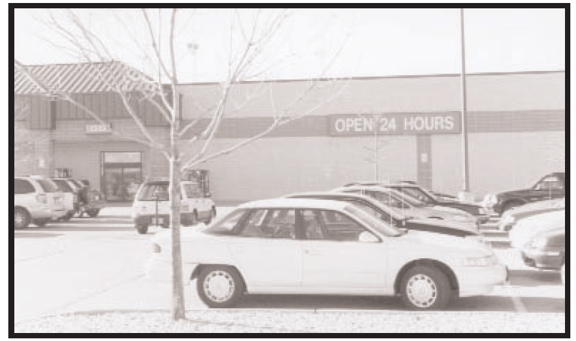
Stores that are open around the clock are protected from burglary by the constant presence of staff. Credit: Kip Kellogg
Size
National victimization surveys conducted in Australia and the United Kingdom have found that smaller shops have lower burglary rates than larger ones.13 This may be due partly to location (downtown shops tend to be smaller than those in retail parks or malls), and partly to the smaller number of goods to steal.
Goods Sold
Research has clearly established that shoplifters exhibit strong preferences in the goods they steal, and that stores carrying these goods are particularly at risk (see the Shoplifting guide in this series). In the United States, shoplifters favor tobacco products (particularly cigarettes), health and beauty products, recorded music and videos, and clothing (designer, in particular). The more-limited research on retail burglaries shows similar preferences,14 with some predictable variations resulting from differences in shoplifting and burglary methods. For example, burglars are more likely to target electronic goods, such as videocassette recorders and televisions, than are shoplifters, who would have difficulty taking such goods out of a store without being seen. A comparison of supermarket goods stolen by shoplifters and burglars found that both groups targeted cigarettes, liquor, and health and beauty aids, but as would be expected, the burglars stole these in much larger quantities than did the shoplifters. The burglars also robbed store ATM machines.15
Length of Time in Business
Newer businesses have higher victimization rates than older businesses.16 This might indicate that stores become more experienced in preventing crime the longer they are in business—or that store survival depends on resisting crime.
Security Precautions
Stores at greatest risk of burglary tend to take the most precautions, and while these precautions may reduce the risk of burglary, they do not entirely eliminate it. It is also the case that stores often increase their security after being burgled. These facts could help explain why some studies have found little statistical relationship between stores' level of security precautions and their rate of burglary.17 However, evaluations of recent crime prevention projects in Britain (the Safer Cities project and the Small Business and Crime Initiative) have concluded that improved security at recently burgled stores can reduce repeat burglaries and, as a result, overall burglary rates in targeted areas.18 In addition, some studies have produced evidence of the effectiveness of specific measures, such as installing burglar alarms and hiring security guards. While often falling short of proof, this evidence is reviewed below in the "Responses to the Problem of Retail Burglary" section.


Free Bound Copies of the Problem Guides
You may order free bound copies in any of three ways:
Online: Department of Justice COPS Response Center
Email: askCopsRC@usdoj.gov
Phone: 800-421-6770 or 202-307-1480
Allow several days for delivery.
Email sent. Thank you.
Burglary of Retail Establishments
Send an e-mail with a link to this guide.
* required
Error sending email. Please review your enteries below.
- To *
Separate multiple addresses with commas (,)
- Your Name *
- Your E-mail *
Copy me
- Note: (200 character limit; no HTML)
Please limit your note to 200 characters.