

Center for Problem-Oriented Policing
POP Center Problems Juvenile Runaways, 2nd Ed. Page 1
Juvenile Runaways, 2nd Ed.
Revised, with new content on Indigenous juvenile runaways
Guide No. 37 (2025)
The Problem of Juvenile Runaways
This guide begins by describing the problem of juvenile runaways and reviewing its risk factors. It then identifies a series of questions to help you analyze your local runaway problem. Finally, it reviews responses to the problem and what is known about them from evaluative research and police practice.
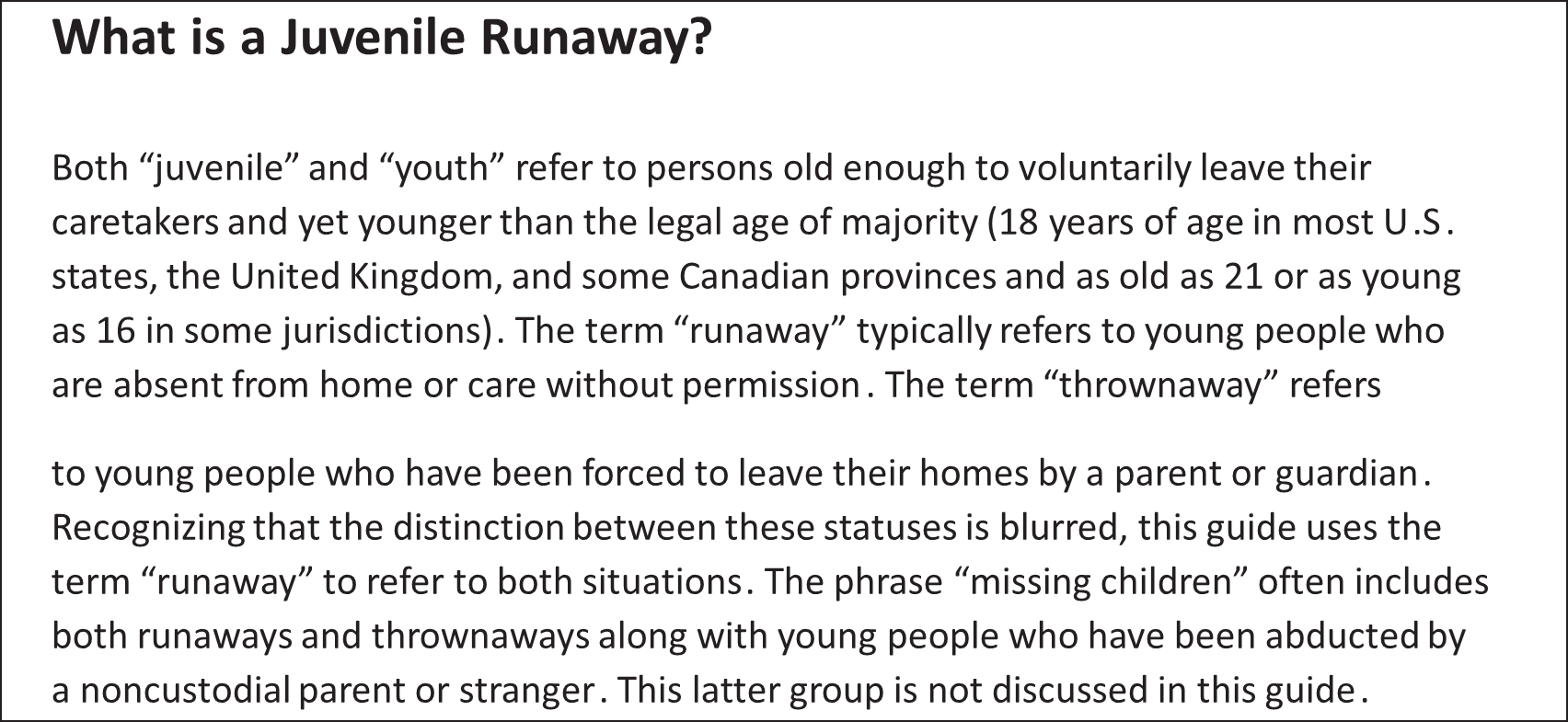
Young people run away both from home and from substitute care placements, such as foster care or group homes. Most decide to leave on their own or choose not to return when expected, but in some cases, their parents or guardians tell them to leave or do not allow them to return (such young people are often referred to as “thrownaway”). A runaway episode refers to an overnight stay away from home, except in the case of young children, who can be in danger after a much shorter time. Runaways—those who voluntarily go missing—were once believed to be youth seeking adventure or rebelling against mainstream values and the authority of their parents; more recently, runaways have been regarded as victims of dysfunctional families, schools, and social service institutions. Some experts have argued for eliminating “juvenile runaway” as an official classification because it tends to lead people to treat the occurrence as less important than a “missing person.”1
In fact, runaways and thrownaways constitute the most significant portion of missing-person cases.2 As many as 1.7 million children run away from home each year, with approximately 20 percent of those cases reported to police. Most runaway episodes last only a day or two (75 percent of such young people return home within a week), and most do not leave their local area.3
Estimating the number of young people who run away is difficult because researchers do not agree on the underlying definition of “running away;” they tend to hide their runaway status when talking to adult authority figures; many do not access services and therefore are not included in service-use data; many runaway incidents are not reported to authorities; some missing-person cases are classified as juvenile runaways and vice versa.
These difficulties notwithstanding, a 2019 report from the Congressional Research Service found that approximately 700,000 youth ages 13 to 17 had experienced homelessness within a 12-month period because they were sleeping in places not meant for habitation, in shelters, or with others while lacking alternative living arrangements. Only about one-third of these young people were actually “missing,” meaning that their parents or caretakers did not know where they were and were concerned about their absence. Only about one-fifth of all runaway episodes were reported to police.4 Some parents do not report runaway episodes to police because they know where their children are or because they do not think the police are needed to resolve the issue.5 Others do not report runaway episodes because they want to avoid police involvement or because they had a negative experience when previously reporting to police.6
The precise number of homeless and runaway youth is unknown because they tend not to stay in one place for long and their status as runaways often overlaps with other classifications.7 Although young people from all socioeconomic statuses run away, the majority are from working-class and lower-income homes, possibly because of the family stress created by a lack of income and resources.8 Blended families also experience stress, which may explain why youth living in these settings are also more likely than other youth to run away.9 Runaway rates are similar for youth in urban, suburban, and rural settings.10
Compared to youth who do not run away, runaways have higher rates of mental health concerns such as depression, victimization by physical and sexual abuse, substance use disorders, commission of delinquent offenses, and difficulties with peers. Many runaways have been exposed to high levels of violence, either as victims or as witnesses, and some respond by engaging in violent behavior themselves.11 Running away and homelessness often go hand in hand, with common risk factors such as family dynamics, substance abuse, mental illness, socioeconomic disadvantage, and lack of education present among both young people and adults.12
Youth in substitute care (e.g., foster care, group homes) are more likely to run away than those who live at home with a parent or guardian. The chances of youth in care running away are highest in the first few months after placement, and older children are more likely to run away than younger ones.13 Youth who run away from substitute care are more likely to run away repeatedly than youth who run away from home.14 Although they are only a small proportion of the total number of youth who go missing, those who run away from care consume a disproportionate amount of police time and effort.15 Those who run away from care also tend to stay away longer and travel farther away than those who run away from home.16
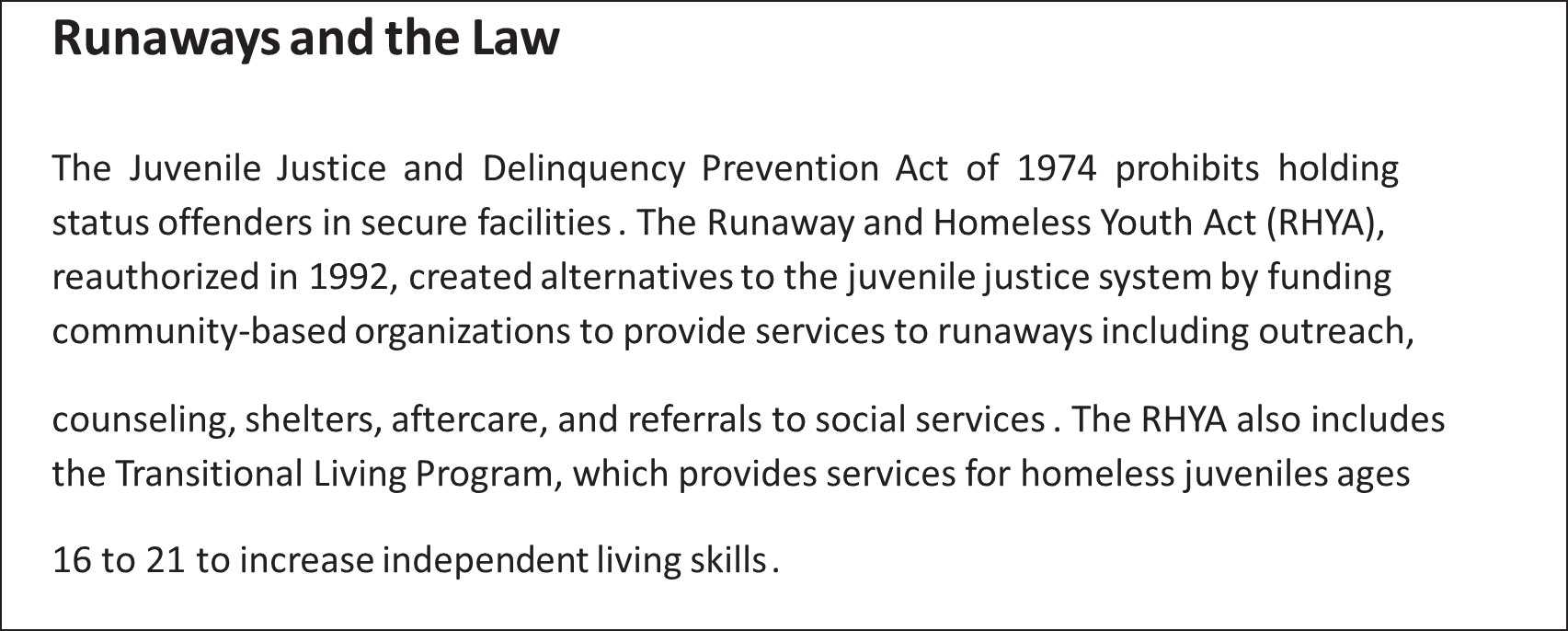
Police encounter runaways, whether reported missing or not, through a number of activities: while patrolling areas where runaways congregate, while investigating missing persons reports, or during criminal investigations in which juveniles were either alleged to be perpetrators or victims.17 Between 2000 (the peak year) and 2020, the number of youth held in juvenile-justice facilities on a typical day fell from 108,800 to 25,000, a 77 percent decline.18 While some runaways are arrested and charged with running away itself as a delinquent act, others are charged with delinquency related to sex work and status offenses such as curfew violations, truancy, and drug and alcohol offenses. Police vary in how they handle runaway cases depending on such factors as whether the children were reported missing, the level of parental or caretaker concern, and the seriousness of the risks the young people are believed to face.
What exactly it means to be “living on the street” varies: Some runaways will have no safe indoor place available to them for food, shelter, and personal hygiene, while others will have occasional access to such spaces. Relatively few runaways are homeless and fully living on the street; most stay in relative safety at a friend or family member’s home. However, some runaways lack safe living arrangements and stay on the street, in the company of a predatory adult, or in another situation lacking responsible adult supervision. Police and policymakers are most concerned about this group because of the potential for victimization and criminal activity.
The problem of runaways is particularly complex because it suggests other family problems. As a result, police may be able to affect only a segment of the problem directly. Although many things can be done to address the problem’s underlying causes, police are primarily concerned about reducing the harm that comes to or is caused by runaways when they are absent from home or care. For example, some runaways are
- involved in criminal activity as perpetrators;
- victimized by criminal activity;
exploited by predatory adults;
engaged in risky behaviors such as drug use and unsafe sexual activity, especially that which is coerced or engaged in to acquire necessities of life (so-called “survival sex”).19
Despite their interest in protecting children’s safety, police may assign low priority to runaway cases for a number of reasons:20
Few jurisdictions have appropriate facilities for placement once runaways are taken into police custody.
Processing paperwork and transporting runaways consume significant amounts of time.
Police might perceive runaway cases as less serious than some other public safety threats.
Some police believe parents and substitute care providers want police to act as disciplinarians or security guards.
Runaway cases may be frustrating when neither the young people nor their parents want them to return.
Young people often run away again shortly after police return them home.
Youth can be held in secure facilities only in limited situations. Unfortunately, the resources available to this population generally amount to a collection of loosely affiliated services and shelters of varied quality and quantity. As a result, police often have limited options for responding to runaways and ensuring their safety.
Related problems
Police encounter young people for many reasons related to their running away. Some of these problems are covered in other guides in this series. These related problems require their own analyses and responses:
Child abandonment
Child abduction by noncustodial parents
Child abduction by strangers
Child abuse and neglect
Child sexual exploitation
Curfew violations
Disorderly youth in public places
Drug dealing
Homelessness
Human sex trafficking
Panhandling
Problems relating to transient persons’ personal care (e.g., sleeping, bathing, depositing human waste in public)
Shoplifting
Truancy
Underage drinking
Factors contributing to juvenile runaways
Understanding the factors that contribute to the problem will help you frame your own local analysis questions, determine good effectiveness measures, recognize key intervention points, and select appropriate responses.
Why they run: Reasons and triggers
Runaways’ home and family situations suggest that the stereotype of young people running away to experience a carefree and rebellious lifestyle is misguided and potentially dangerous. Runaways are usually running away from a problem they do not know how to solve, rather than running to an environment they imagine to be more relaxed and exciting. Triggers for running away from home include the following:21
- Recurrent arguments about parent-child issues such as autonomy, spending money, staying out late, permission to attend a parties or concerts, arguments with siblings, choice of friends, appearance, showing respect to parents, criminal behavior, alcohol or drug use, and school problems (truancy, suspension, grades)
Physical and sexual abuse
Tension or rejection because of personal characteristics
Efforts to avoid a difficult encounter with parents, e.g., revealing a pregnancy, reporting failing grades
Rigid rules or expectations that do not account for normal developmental changes, punishments perceived as excessive, or authoritarian parenting styles
Seeking fun or adventure, to be with a romantic partner, or to do something parents will not permit
Parents’ setting poor boundaries, failing to set limits on tolerated behavior, neglecting children, abusing substances, depression, or inability to cope with their own stress
Parents’ disharmony, arguing, or domestic violence
Tension with a stepparent or problems adjusting to a split or blended family
In general, young people run away from families that tend to retreat from rather than work through difficult situations. Lacking other coping mechanisms or communication strategies to resolve problems, young people often run away when they feel they have no other option. In particular, young people run away when the pattern of conflict escalates, the risk of physical harm increases, or family life becomes intolerable.
The triggers underlying a runaway episode from foster care or a group home may be different from those underlying a runaway episode from home. When youth in care do not have strong emotional ties to their caretakers, they often find it easier to leave.22 Young people run away from care to
- return home or to their neighborhoods to spend time with friends, romantic partners, and family;23
get attention or provoke a reaction—to confirm that caretakers care about them and they are wanted;24
escape crowded facilities or seek privacy;25
protest inadequate service or attention from social workers;26
protect themselves from bullying or sexual harassment by other residents;27
escape abuse by staff;28
resist imposed limits, particularly as many young people in care come from homes with few limits.29
Young people in the foster care system are often shuttled among multiple placements. These disruptions can cause them to feel disempowered and detached and may lead to runaway episodes.30 The substitute care placement’s culture or environment may also create an incentive to run away. Placements lacking structure and activities and those with overwhelmed staff who do not exercise their authority properly have higher rates of runaways than facilities with strong leadership, staff support, and young people involved in activities and setting rules.31
In sum, there are usually multiple factors that determine whether a young person runs away from home or a care facility. Complex though it might be, understanding each child’s personal motivations for running is important to reducing the behavior.32
When they run: Seasonal and temporal issues
Some evidence suggests that, in some communities, young people run away more often in the summer and during the afternoon or evening, while in other communities, there are no clear patterns with regard to season, day of the week, or time of day.33 Local practices surrounding curfew and truancy enforcement may cause police to come into contact with runaways more often on particular days of the week or times of day.
How they go: Methods of departure
Most young people leave home or care spontaneously amid emotional or physical conflict. Their departure is generally poorly planned and impulsive, and they usually do not take any food, clothing, or money to sustain them while away. Others carefully calculate the timing of their exits; leave notes announcing their departures; and take money, food, clothing, and objects of sentimental value with them.34 They use many modes of transportation: walking, taking the family car, organizing a ride with friends, using public transportation, or hitchhiking. Obviously, some of these choices involve serious risks to their safety.
Discovering that a child has run away can be very emotional for parents. They may blame themselves and feel guilty, remorseful, or inadequate, or they may blame the child, feel angry, and plan to punish them.35 Some parents are less affected by their child’s departure, believing they went to a safe location and will return shortly.36 Parents try to locate the child by calling friends and relatives, searching places the child frequents, or filing a missing persons report with the police.
Where they go: Destination
Most runaways do not go far. Only about one-quarter leave their local area, and few of these leave the state.37 Young people who run away from care tend to travel farther than those who run away from home and are more likely to leave the state.38 The cities of New York, San Francisco, and Los Angeles attract large numbers of out-of-state runaways.39

Very few runaways identify “the street” as their initial destination when they run away from home or care. The most common intended destinations are the homes of friends or relatives. Often, parents or caretakers know where runaway children are staying.40 Young people who stay away for longer periods of time tend to cycle through a series of temporary stays with friends and relatives, a practice called “couch surfing.” Only when these resources are exhausted do they move out to the street. Although the proportion of runaways who live outside, in a public place, or in an abandoned building is relatively small, these young people are often in great peril and at risk of falling prey to predatory adults, drugs, and violent crime.41 Police are most likely to encounter these young people, and they are the ones who arouse the greatest concern. Runaways vary in their “street survival” skills, with the more skilled less motivated to leave street life.42
How long they stay: Duration
About one-fifth of runaways return within 24 hours, and after one week, three-quarters of all runaways have returned home or to care.43 Less than 1 percent of runaways never return. Even when their absences are short, runaways are still at higher than risk of harm than other young people, particularly if they are not staying in a safe location.
What happens while they are gone: Consequences
Once young people have left home or care, the variety and seriousness of harms they face depend on several factors, including
- their level of maturity;
- the availability of safe accommodations;
- their companions and associates.
Survival and safety issues are fairly minimal concerns for the large majority of young people who stay with friends or relatives.44 Over time, friends and relatives may become less willing to provide for them, and the young people either return home or move to the street. Those living on the street face hazards endemic to their environment (such as substance use and consensual high-risk sexual activity), inflicted by others (victimization and exploitation), or motivated by their need to obtain food, shelter, and money (panhandling, prostitution, thefts, etc.).
Young people living on the street develop survival strategies. Sometimes they access shelters or emergency care facilities; other times they are forced to settle for riskier arrangements such as staying with strangers who have apartments or living in abandoned buildings or on rooftops. They may shoplift, panhandle, steal, threaten, or use violence to get money from others.45 Although there is no consensus on whether the practice is widespread, some young people also engage in survival sex, meaning they trade sex for food, shelter, drugs, or protection.46 Sometimes, depending on the young person’s age along with other factors, survival sex involves statutory rape, which has obvious implications for police.
Some acts of survival sex are the result of the circumstances a runaway may face; however, some runaways living on the street are exploited by predatory adults and become involved in sex work or drug dealing or are the subjects of child sexual abuse or exploitation material.47 Young people may run away because they have experienced physical or sexual abuse at home or in care; they often experience the same types of assault while living on the street.48
Runaways living on the street may put themselves in jeopardy by using drugs. Substance use is frequent among runaways: Two-thirds of missing and runaway children reported having used drugs at least once.49 Illegal drugs are very accessible to those on the street, who tend to use them both as social lubricants and to self-medicate.50 Large numbers of young people on the street also engage in unsafe sexual activity.51 These behaviors, coupled with the harms inflicted by others, create serious physical and mental health dangers. Many runaway youth have both substance use and mental health issues.52 Poor nutrition, poor hygiene, and exposure to the elements lead to physical illnesses.53 Given their high levels of intravenous drug use, shared drug paraphernalia, and high-risk sexual behaviors, young people on the street are vulnerable to HIV and other sexually transmitted infections.54 Finally, their stressful lives coupled with their troubled backgrounds of abuse or neglect make them susceptible to suicide and to depression, and other mental illnesses.55
Many runaways living on the street constantly fear victimization and struggle to meet their basic survival needs. Very little is known about the experiences of runaways who do not spend time on the street. Some young people feel independent, autonomous, and free and are relieved to escape the pressures of family conflict and school. Being away from home— if one has a safe place to stay--can provide runaways time to think and try to sort out their problems. Unfortunately, running away tends not to improve juveniles’ emotional lives for the long term, nor does it address the issues that made them want to leave home.56
How or if they return
Most runaways eventually return to their homes, placements, or another safe alternative. Sometimes they return on their own; sometimes they are located by a parent, guardian, friend, or relative and convinced to return; sometimes they are apprehended by police and brought home; and other times, their return is negotiated by a shelter or other social service working on their behalf. They may return with the hope of reconciling or because they are tired of their stressful life on the street.57
Although shelters and other social services may negotiate the young person’s return, families rarely receive the comprehensive services needed to resolve the issues causing the child to flee in the first place.58 Some runaways do not want to return home and avoid contact with services and authority figures so they are not forced to do so. Similarly, some parents blame the young people for running away and do not recognize their own contributions to the problem.59 In these situations, automatic or immediate reunification may place the young person at risk of continued harm.
Special considerations for at-risk youth
Special considerations for at-risk youth involve several issues and variables, and the data regarding the incidence of running away vary by state and by study population. Gambon et.al. notes, “The data regarding the distribution of runaway youth from racial and ethnic minority backgrounds are inconsistent. However, more recent data from the National Runaway Safeline reveal that youth of color seem to be overrepresented among runaway youth in crisis who are connecting with the Safeline; 23 percent of those youth connecting identify as Black or African American, compared with 14 percent of the general population.” Additional data on American Indian / Alaska Native youth who have run away is also limited, as the following section discusses in more detail. It is estimated that one in every 130 American Indian / Alaska Native children go missing each year. The number missing is likely to be higher, but because there is no centralized reporting system in tribal communities information on American Indian / Alaska Native youth is limited.
What is clear is that youth from racial and ethnic minority groups are at a higher risk than White youth for running away. Specific risk factors for running away are discussed in the Why they run: Reasons and triggers section of this guide.
Missing or murdered Indigenous juvenile runaways
The majority of missing Native American young people are runaways,60 though the vast majority of those who are reported missing to the National Crime Information Center (NCIC) are located and returned home. Tribes that provide their own law enforcement are the primary responders to a report that a young person has run away from home or other residential placement in their jurisdiction. If further investigation indicates foul play, involuntary, or at-risk components to the case, tribal police might be able to get assistance from the Federal Bureau of Investigation (FBI), local sheriff, or city police.61
Tribal members might feel that runaway cases involving tribal youth are not treated with the same priority as others, especially when the state, rather than the Federal Government, has primary law enforcement responsibility. When a tribal youth goes missing from tribal land, it is important to know which law enforcement agency bears the primary responsibility for investigation and which other agencies are willing and able to assist in the case. Accordingly, it is critical that tribes develop their own Tribal Community Response Plans (TCRP) to enhance collaborative response to runaway cases. In the TCRP, tribes are encouraged to report all young people as missing if their whereabouts are unknown. Tribal police are encouraged to take a missing persons report on all cases involving children and youth, including individuals who have a history of running away. When tribal youth run away from the reservation or tribal lands to cities, jurisdiction becomes more complicated because tribal authority generally ends at tribal land borders unless other law enforcement agencies have cross-deputized tribal police. City police might have limited time and resources to devote to runaway or missing young people from other jurisdictions. Collaborative partnerships and agreements can help address these challenges.

